
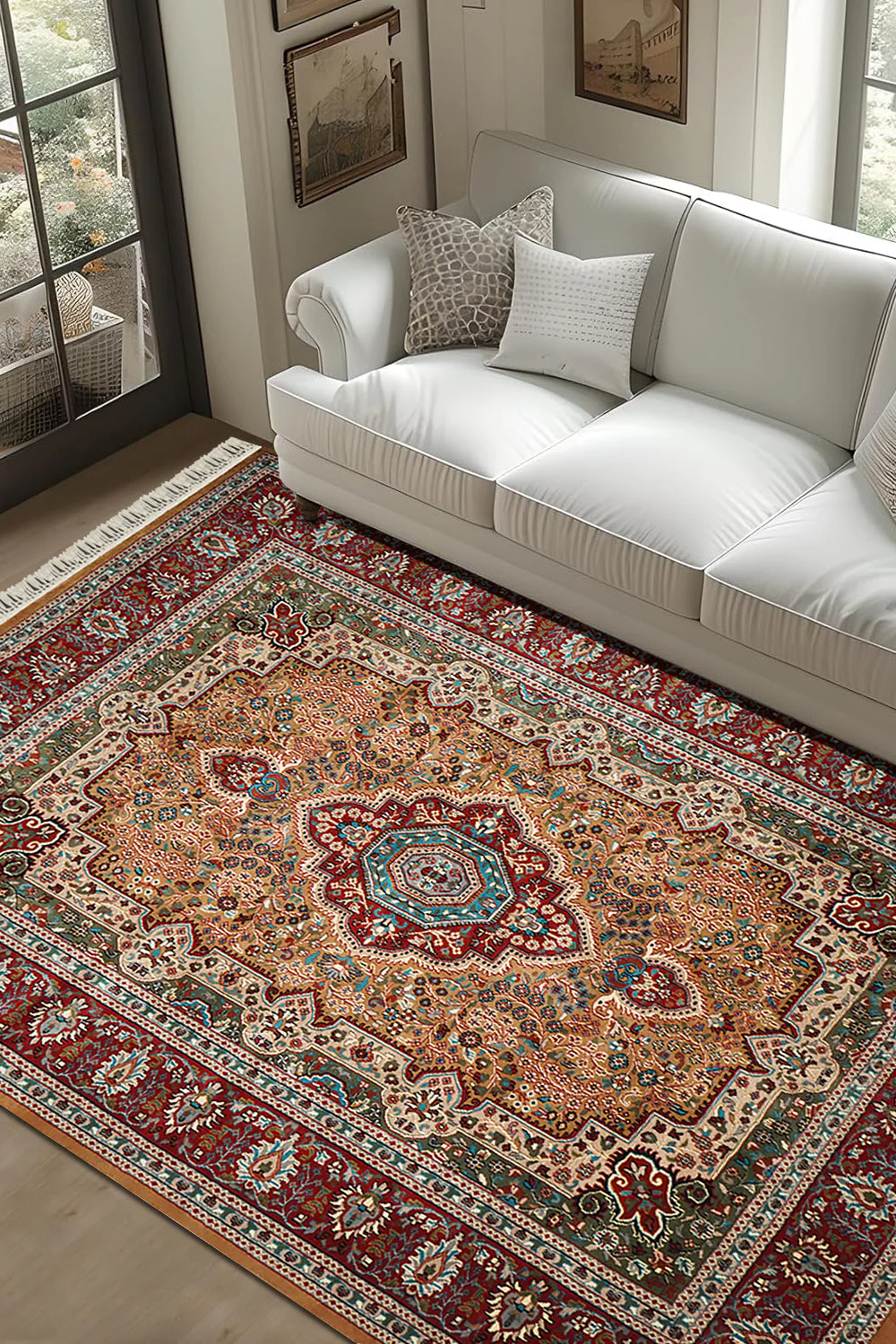
There are certain things in design that never quite become trends, because they never quite stopped being true. Persian rugs and carpets are one of them.
For over two and a half thousand years, the weavers of Persia produced floor coverings that were, in the most literal sense, manuscripts: dense with symbolism, deliberate in colour, and shaped by a belief that the objects in a home should carry meaning alongside beauty.
Courts commissioned them. Merchants traded them across continents. Mughal courts had them. So did Medici households. The through-line isn’t cultural, it’s that people with discernment, across centuries, kept arriving at the same conclusion. A room with one of these handmade rugs simply reads differently than a room without.
To understand why, it helps to look a little beyond the surface.
The Colour Philosophy Of Persian Rugs
In Persian weaving tradition, colour was never decorative in the superficial sense. It was philosophical. Colour in these rugs and carpets was never incidental. Every hue carried a specific weight. Some tied to the household, others to the occasion, and sometimes simply the beliefs of the weaver themselves.
Red is the most immediate example. Traditionally drawn from madder root, it produced a crimson that shifted in depth and character depending on the region. A Tabriz red rug and a Kashan red carpet are recognisably different things. What they share is what red was always meant to hold: vitality, courage, the feeling of a home that is fully inhabited. In certain traditions, it was also believed to offer protection. You placed red in a home the way you would commission something of lasting importance.
Blue, produced from indigo, spoke of spiritual depth, trust, and the divine. It appears heavily in rugs from weaving centres near religious sites, where it was also held to guard against the evil eye. It is a colour of extraordinary interior calm, which perhaps explains why it translates so naturally into contemporary spaces that prize restraint.
Green was handled with particular care. Green is where the spiritual dimension becomes most visible. It carried associations that make weavers approach green carpets differently than any other colour. Natural green dyes were genuinely hard to produce, usually arrived at by overdyeing yellow thread with blue, and the difficulty seemed to deepen the respect around it. In some rugs, green was deliberately kept away from areas of heavy foot traffic. Not as a design choice. As a form of care.
Gold was simpler in its symbolism – wealth, patronage, power. It appeared in rugs made for courts and prominent families, and it looked exactly like what it was.
Each colour, in other words, was a deliberate act of meaning-making. To look at a Persian rug with this knowledge is to read something that was written specifically to endure.
The Motifs and What They Hold
The design vocabulary of Persian rugs is deep, but certain motifs recur across centuries and regions with a consistency that speaks to their resonance.
- The Herati Pattern: It is known as “Mahi,” the Persian word for fish. The rug features a flower at the centre of a diamond. The centre is then surrounded by four curving leaves that bear a resemblance to fish in motion. Originating from the ancient city of Herat, it became one of the most widespread designs in Persian carpet history. Its symbolism is rooted in abundance and water. The pattern was also believed to bring good fortune to any household it entered.
- The Boteh: The motif which is also called paisley in many cultures. Scholars have traced it to a stylised flame, a cypress tree (a Zoroastrian symbol of eternity), or a cluster of leaves. What is certain is that it carries a quiet authority that centuries of reproduction have not diminished. It appears in handcrafted rugs from Bijar, Ferahan, and Herat, and it remains, in any context, distinctly itself.
- The Central Medallion: The central medallion is the most architecturally grounded of Persian rug designs, and its origins explain why. It moved into carpet-making from 15th-century Persian manuscript covers. A century later it was appearing in the great Tabriz commissions of the 1500s. The geometry mirrors a mosque dome: everything organised around a still centre. Some versions hold triangular amulets at their core, intended to protect whoever lives within the home.
- The Tree of Life Motif: It’s a tree rising from the base of the rug. Its branches reaching upward carries one of the oldest symbolic architectures in human culture: the roots in the earth, the trunk in the present world, the branches stretching toward the divine. A rug with this design was understood as a kind of threshold, connecting the domestic to the transcendent.
Why the Contemporary Interior Keeps Returning to This Language
The most considered interiors of this moment share a particular quality: they feel complete rather than composed. There is a difference. A composed room has been arranged. A complete room has a soul.
There’s something Persian-inspired rugs do that most contemporary furniture simply doesn’t. They give the eye somewhere to travel. Not in a busy or overwhelming sense, but slowly, across a surface that keeps revealing itself the longer you look. A Herati field or a medallion composition sits against them in a way that feels almost corrective. The room becomes warmer without anything having been added to the walls. Not as nostalgia. As a counterpoint.
There is also the matter of scale. A well-chosen rug is the only element in a room that organises everything above it, defining zones, anchoring furniture, setting the emotional register of the entire space. Interior designers have, increasingly, begun to establish room layouts from the rug outward rather than the reverse. It is the right instinct.
The Kesari Home Perspective
At Kesari Home, the Persian design tradition is not a reference point so much as a continuing conversation. Several of our collections draw directly from this vocabulary, the geometric confidence of tribal forms, the flowing intricacy of floral medallion layouts, the understanding that colour should mean something before it does anything else. We are not in the business of reproducing antiques. We are interested in what this design intelligence looks like when it is carried forward with contemporary craft and intention.
A home furnished thoughtfully deserves a floor that thinks just as carefully.
Explore the Kesari Home rug collection today.


