The regulatory landscape for residential infill in Bellevue has shifted meaningfully in the past eighteen months. As of the 2026 Omnibus Code Amendments, the maximum allowable height for a Detached Accessory Dwelling Unit within most R-1 through R-5 zones has been raised from 24 feet to 28 feet. That four-foot increase is not cosmetic. It unlocks a viable second story with full ceiling heights, code compliant stair runs, and functional attic or conditioned loft space. For owners who have been waiting on the sidelines, this is the trigger they needed. The permissive envelope, however, does not reduce the technical burden. If anything, it raises it.
Contractors working the Eastside market already know that Bellevue home remodeling is a jurisdiction specific practice, and DADU work is its own subcategory within that. The staff at the Development Services Department reads site plans carefully, and they will return a submittal for coverage miscalculations, setback violations, or inadequate drainage narratives without much patience. Understanding the new code text is the entry ticket, not the finish line.
The 2026 Regulatory Shift in Context
The 28 foot allowance arrived as part of a broader state level push to increase middle housing stock, but Bellevue layered its own requirements on top. A DADU built to the new maximum height still must comply with the local Building Services permit track, commonly referenced as the BS Permit. This is not the same pathway as a primary residence permit, and it carries its own review sequence covering structural, mechanical, plumbing, electrical, and energy code compliance under the currently adopted WSEC amendments.
Height is measured from average building elevation, not from the lowest grade. On a sloped Eastside lot, that calculation is where many owners lose buildable volume before they even begin. A lot falling six feet across the DADU footprint gives a different usable height profile than a flat parcel, and the 2026 amendments provide no topographic relief beyond the standard calculation method.
Site Feasibility Before Design
Before any schematic drawing begins, the responsible approach is a parcel level feasibility study. Lot coverage ratios in Bellevue vary by zone, but most single family lots cap total impervious coverage somewhere between 35 and 50 percent. A primary residence, driveway, patio, and proposed DADU must all fit inside that ceiling. I have walked away from projects in Somerset where the existing patio and primary footprint already consumed the allowable coverage, leaving no room for a two-story detached unit without demolition concessions elsewhere on the parcel.
Setbacks present a second constraint. In Somerset and Newport Hills, rear yard setbacks of five feet are typical for DADUs, but side yard requirements tighten when an eave or gable wall projects toward a neighbouring property. Clyde Hill, which operates under its own municipal code adjacent to Bellevue, applies different standards entirely, and work in that jurisdiction requires a separate permit track. Owners who assume a Bellevue consultant can simply transpose drawings across the city line are usually surprised.
Tree retention ordinances add a third layer. Bellevue protects significant trees on private property, and a 28-foot structure with a drip line impact on a protected cedar can trigger arborist review, root protection zoning, and in some cases a full redesign. These findings belong at the feasibility stage, not in the second round of permit comments.
Why a Single Accountability Structure Matters
Integration between structural engineering, civil work, and the utility connection process is where DADU projects most often stall. Water and sewer tap fees, side sewer capacity analysis, and electrical service upgrades each involve separate departments and separate timelines. When these workstreams split across multiple vendors, coordination failures surface as change orders and schedule slippage.
This is the primary argument for engaging a desing build firm rather than assembling a piecemeal team. A single entity carrying the structural engineering contract, the permit procurement responsibility, and the construction execution can resolve conflicts at the shop drawing level rather than in the field. When the framer discovers that an engineered beam over the garage door does not clear the new DADU water line, someone needs to own that decision in real time. Divided responsibility produces delay. Consolidated responsibility produces resolution.
Structural Integration with Existing Systems
A technically correct DADU does not look like an addition. It looks like it was there all along. Achieving that outcome requires discipline in three areas.
1.1.1 Foundation Continuity
Most Eastside lots have primary residences built between 1960 and 1995, on spread footing foundations of varying quality. A new DADU foundation must account for soil conditions that may have changed since the original construction, including lateral pressures from added impervious surface runoff. Seismic retrofitting of the primary structure is often recommended concurrently, particularly where the two foundations share a drainage plane or retaining element. Geotechnical reports are not optional on sloped lots above a certain gradient, and the 28 foot height increases the lateral load calculations that the engineer of record must sign.
1.1.2 Roofline and Massing
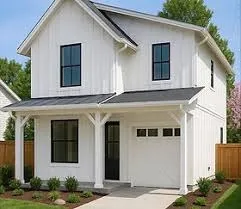
A 28 foot DADU cannot read as a box dropped behind the house. Roof pitches, eave depths, fascia profiles, and window proportions should reference the primary residence. In neighbourhoods like Newport Hills, where mid century ranch forms dominate, a steep gable DADU will look wrong regardless of its finish quality. Matching the massing language is not a style preference. It is a resale and neighbourhood compatibility requirement, and appraisers in the Eastside market do notice.
1.1.3 Envelope and Material Detailing
Exterior cladding, trim reveals, and fenestration should either match the primary or deliberately contrast in a way that reads as intentional. The envelope assembly itself must meet current energy code, which means the DADU will almost certainly carry a more rigorous wall section than the house it sits behind. Managing that disparity at transition zones, such as a shared breezeway or covered walkway, is where experienced detailing earns its fee.
Closing Position
The 2026 height increase is an opportunity, but it is an opportunity that rewards technical discipline. Owners who approach the DADU process as a zoning question will find themselves stalled at the permit counter. Owners who approach it as an integrated building science problem, with feasibility, engineering, permitting, and construction under unified accountability, will build something that adds long term value to the parcel. The code opened the door. The execution still belongs to the builder.